7 Best Supply Management Virtual Assistants in 2026
Your supply manager is drowning in purchase orders, vendor emails, and inventory spreadsheets. Hiring locally takes months, and many platforms bury you in setup fees before you see a single qualified candidate. That gap pushes most operations teams to start comparing virtual assistant providers.
This guide breaks down what actually matters when vetting supply management VAs, from ERP and procurement system experience to pricing models and replacement terms. You will get seven provider reviews, a clear top pick, and the criteria to match a VA to your order volume, vendor count, and software stack.
What to Look For in Supply Management Virtual Assistants
Hiring a supply management virtual assistant in 2026 requires evaluating candidates beyond generic admin skills. They must understand procurement workflows, ERP systems, and compliance requirements specific to your supply chain.
A procurement virtual assistant sits close to money, contracts, and supplier relationships, so a wrong hire creates real operational risk. The evaluation criteria below focus on the two areas that separate qualified candidates from generalists: proven systems experience and a verifiable hiring process.
Remote work has widened the talent pool for 2026 supply chain staffing, but it has also made rigorous vetting more important. Anyone can claim familiarity with purchase order processing or vendor management on a resume. Structured screening is how you confirm those claims before granting system access.
Supply Chain Experience and Systems Knowledge
A supply management VA must be proficient in the specific ERP and e-procurement platforms your business uses, such as SAP Ariba, Coupa, Oracle Procurement Cloud, or NetSuite, and understand how these systems connect with your broader supply chain operations.
Look for hands-on experience across the core transaction cycle: requisition to purchase order, invoice processing, and supplier onboarding. Ask candidates to describe a spend analysis report they built and what decisions it supported. A sourcing virtual assistant should also speak fluently about RFQ management and bid evaluation support.
Practical tests reveal more than interviews. Consider these exercises:
- Ask the candidate to walk through creating a purchase order in a specific system, step by step.
- Present a vendor invoice discrepancy and ask how they would reconcile it.
- Give a short dataset and request a summary of spend by category or supplier.
- Ask how they would set up a new supplier record, including which documents they would collect.
Verify certifications and training tied to these tools rather than accepting vague claims. A candidate who can explain ERP integration points, such as how purchase order data flows into inventory management or contract administration support, is likely to ramp up faster and need less supervision.
Pricing Models and Vetting Standards
Pricing for supply management virtual assistants typically follows one of three models: hourly, monthly retainer, or a one-time recruitment fee, and the vetting process should include skills testing, background checks, and reference verification specific to procurement roles.
Each model carries tradeoffs. Hourly arrangements, often in the $10 to $30 per hour range for freelance VAs, suit fluctuating workloads but can cost more over time and offer less continuity. A full-time dedicated VA on a monthly retainer, commonly $1,500 to $3,000, provides consistent remote procurement support and deeper familiarity with your systems. One-time recruitment fees, roughly $1,000 to $2,500, buy a structured search but leave employment and management with you.
Vetting standards matter as much as price. A sound process includes resume screening for procurement experience, technical assessments such as Excel proficiency and an ERP simulation, behavioral interviews, and criminal and credit background checks. For roles touching payments and supplier data, these checks are not optional.
Ask providers direct questions before committing:
- What screening steps do candidates complete before you present them?
- Do you offer replacement guarantees if the placement does not work out?
- Are trial periods available so we can assess fit on live tasks?
- How do you verify prior procurement experience and tool certifications?
Documented answers to these questions separate serious staffing partners from resume mills, and they give you a fair basis for comparing the options that follow.
1. Aristo Sourcing - Best Overall
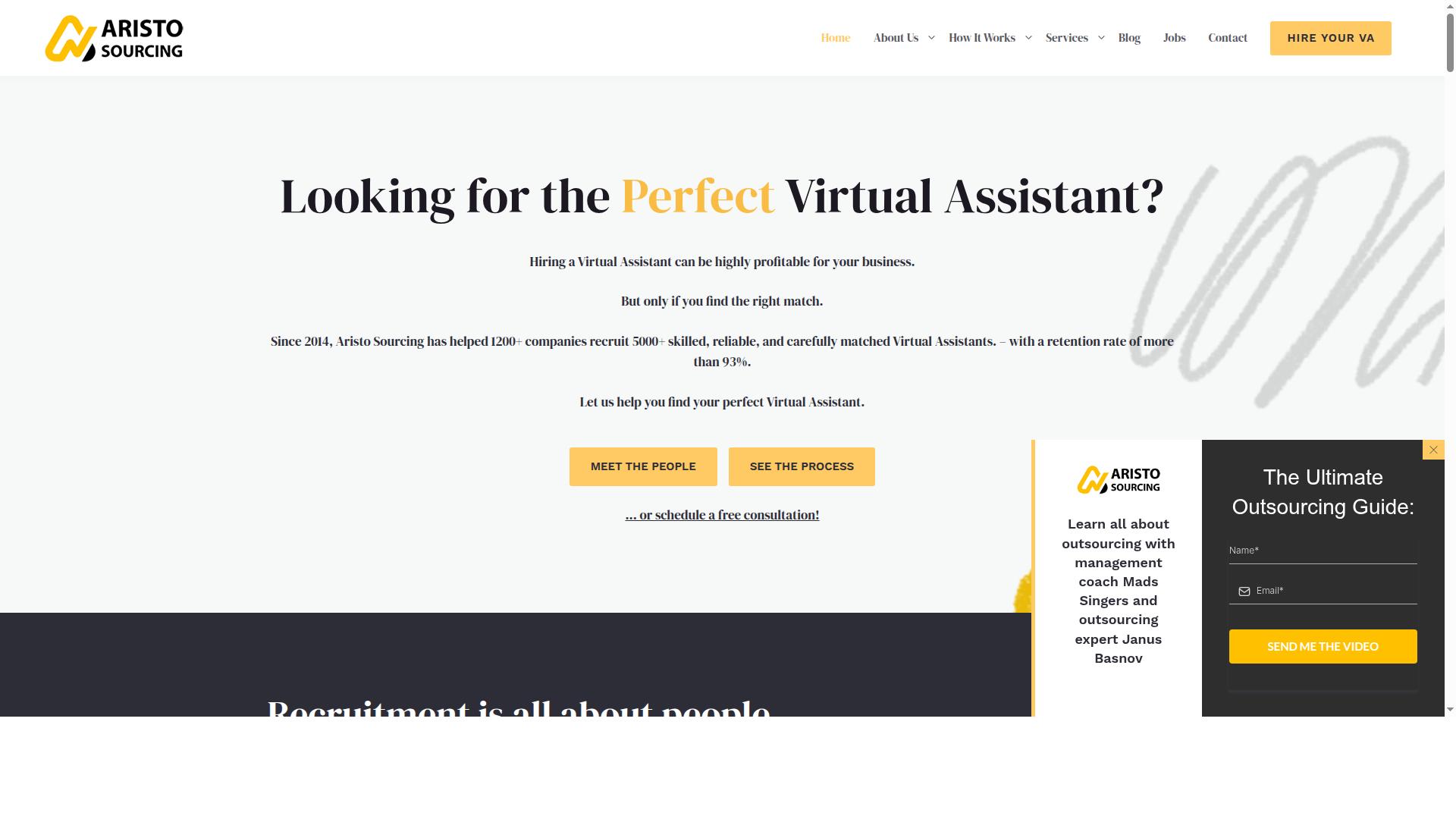
Aristo Sourcing stands out as the best overall supply management virtual assistant provider for 2026 due to its specialized recruitment process, comprehensive replacement guarantee, and proven track record in placing procurement professionals. The agency has helped 200+ companies recruit 500+ skilled Virtual Assistants since 2014, with a retention rate of more than 93%.
Unlike generalist VA agencies, Aristo Sourcing treats supply chain and procurement roles as a core specialty rather than an afterthought. That focus shows in the customized matching process, where candidates are screened against the specific demands of sourcing, purchasing, and vendor coordination work.
The talent pool spans the Philippines and South Africa, giving clients in different regions a genuine choice of remote procurement support. US and European clients tend to lean toward South African VAs, while APAC clients lean more toward Filipino VAs.
Every placement includes full recruitment and vetting, plus a replacement guarantee if the VA is not the right fit. For teams building out 2026 supply chain staffing, that combination of specialization and backup removes much of the hiring risk.
Supply Management Roles, Pricing, and Replacement Guarantee
Aristo Sourcing places full-time remote team members in roles such as procurement virtual assistants, vendor management assistants, and inventory management assistants, with two pricing options: a US$400 monthly fee (on top of VA salary) or a US$1,999 one-time recruitment fee. The monthly model means the invoice includes the VA salary and everything else.
The one-time fee suits companies that prefer to hire directly and pay the salary like any other employee. Either way, recruitment and vetting are included, so clients are not sorting through unqualified applicants on their own.
Beyond the core procurement VA role, the agency fills several adjacent supply management positions:
- Purchase order processing assistants
- Spend analysis assistants
- Contract administration support
- RFQ management and bid evaluation support
These roles map directly onto the daily workload of a procurement team, from purchase order processing through supplier relationship management. A sourcing virtual assistant can also take on document control and coordination tasks that keep e-procurement workflows moving.
The numbers behind the service are worth noting. Aristo Sourcing reports a low 7% VA replacement rate, and 90% of clients stay with them for 12 months or longer. That 93% long-term placement figure compares favorably to the BPO industry average of 70%.
VAs are recruited primarily from the Philippines and South Africa and are flexible in matching clients' time zones. For supply chain teams coordinating across regions, that flexibility matters as much as the skill set itself.
The replacement guarantee applies if a placement is not the right fit, which keeps the risk of a bad match low. Combined with the customized matching process, it explains why so many clients remain past the one-year mark.
2. Wing Assistant
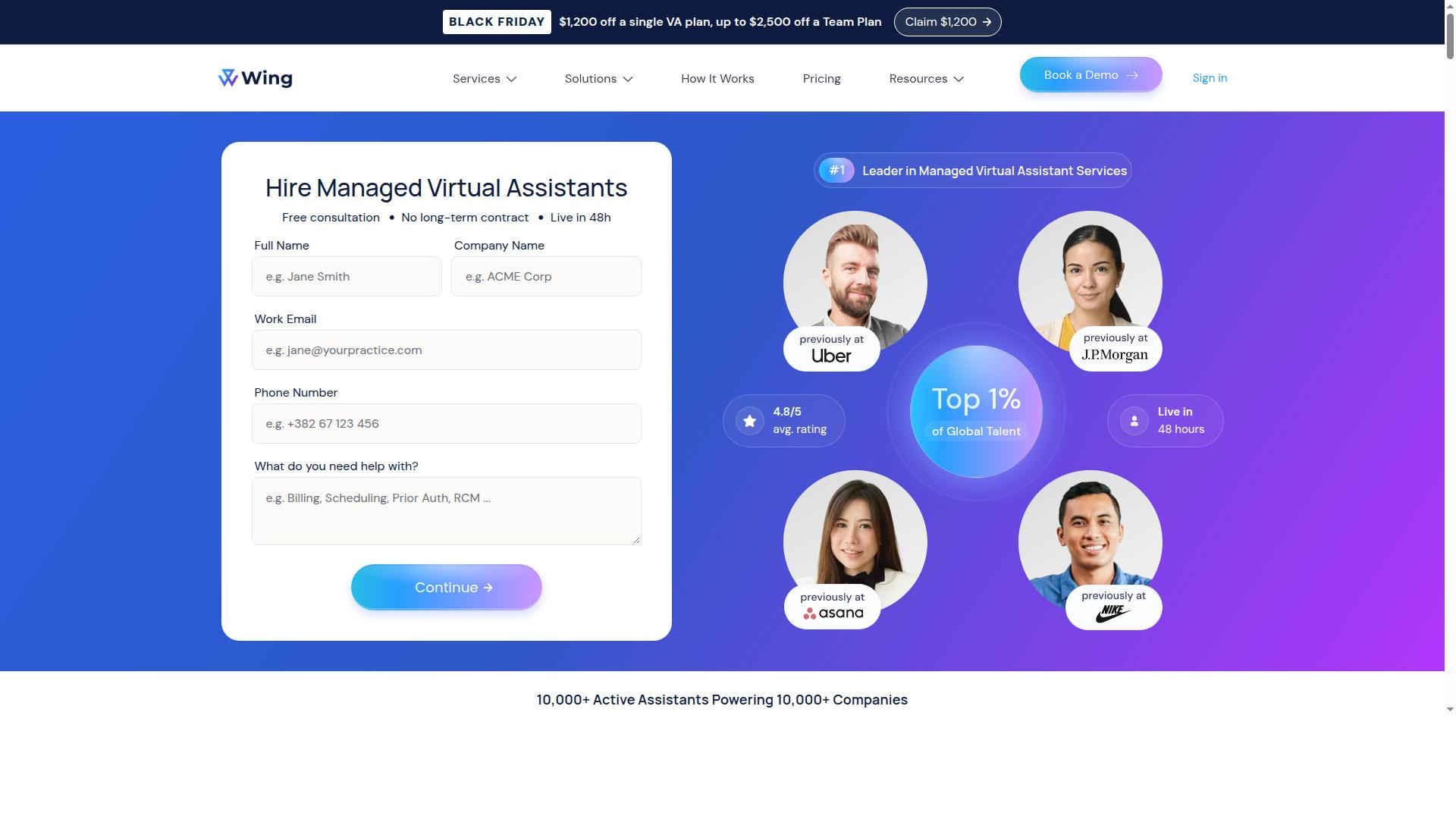
Wing Assistant offers a range of virtual assistant services, including procurement support, with a focus on tech-savvy assistants and flexible pricing plans. The service is built around dedicated assistants rather than a shared pool, which gives clients a consistent point of contact for recurring tasks.
Beyond general admin work, Wing Assistant covers customer service, bookkeeping, and executive assistance roles. For supply management virtual assistant duties, buyers should treat procurement as a possible add-on rather than a core specialty.
That distinction matters in 2026 supply chain staffing. A capable general assistant can handle data entry, calendar coordination, and document filing, but deeper work like RFQ management, bid evaluation support, or supplier relationship management often calls for someone with dedicated sourcing experience.
Wing Assistant's published plans are transparent and month-to-month. The general virtual assistant option runs $999 per month for 160 hours, with a part-time tier at $699 per month for 80 hours. Specialized role plans range from $1,299 to $2,999 a month, and US-based plans sit between $2,499 and $4,999.
A few terms are worth noting before signing. Card payments add $35 USD per client per month, and a three-month agreement takes 3% off. There is no long-term contract, though monthly auto-renewal requires 10 calendar days' cancellation notice.
Included features cover free replacement, a Customer Success Manager, and support across your timezone and any working hours. Part-time plans cap file sharing and storage at 10 GB, which is a practical limit for teams handling heavy purchase order processing or document archives.
Wing Assistant tends to suit founders, executives, and small teams that want a dedicated remote helper without a long commitment. Its strengths are flexibility and breadth: one assistant can absorb admin, operations, and light customer support tasks as needs shift.
For supply management specifically, the fit depends on scope. A procurement virtual assistant role that leans on task automation, workflow automation, and document handling is a reasonable match. Work requiring procurement software integration, ERP integration, or familiarity with e-procurement tools such as SAP Ariba, Coupa, or Oracle Procurement Cloud should be verified in detail during onboarding.
- Pros: flexible monthly plans, no long-term contract, free replacement, dedicated assistant model
- Cons: procurement depth is not guaranteed, storage limits on part-time plans, card payment fee
Before committing, ask directly about prior experience with vendor management assistant duties, spend analysis assistant tasks, and contract administration support. Confirm whether the assigned assistant has worked inside NetSuite procurement or similar systems. A short trial period helps confirm whether the skill match holds for ongoing supply chain work.
3. Cloudstaff

Cloudstaff is a prominent outsourcing provider that offers dedicated remote staff, including procurement and supply chain assistants, with a focus on long-term placements. The company operates primarily from the Philippines and maintains a broader regional footprint, giving clients access to a large pool of English-speaking professionals across several time zones.
For supply management work, a Cloudstaff placement can cover day-to-day procurement support such as purchase order processing, vendor correspondence, and data entry into e-procurement tools. Many offshore staffing firms serve multiple industries, so the depth of procurement experience varies by candidate. Readers should confirm specific supply chain exposure during screening rather than assume it from the provider's general marketing.
Cloudstaff is best understood as a generalist staffing partner rather than a procurement specialist. That distinction matters in 2026 supply chain staffing, where familiarity with ERP integration, RFQ management, and supplier relationship management workflows can separate a productive assistant from one who needs months of ramp-up.
Before committing, ask direct questions about the candidate's hands-on history with procurement software integration, spend analysis assistant tasks, and contract administration support. A short paid trial period is a practical way to validate fit.
Cloudstaff generally prices on a monthly per full-time employee model, which bundles recruitment, facilities, and administrative overhead into a single recurring fee. Exact rates are quoted per role and location, so request a written breakdown that separates the staffing fee from any setup or equipment charges.
The provider is also known for operating staff from office-based and remote setups, a differentiator for buyers who want supervised work environments with backup power and connectivity. Others prefer fully remote placements for cost flexibility. Confirm which model applies to your role before signing.
Due diligence should cover a few practical points:
- Ask for the specific procurement tools the candidate has used, including any exposure to SAP Ariba, Coupa, Oracle Procurement Cloud, or NetSuite procurement.
- Request sample outputs such as a cleaned vendor master list or a completed RFQ tracker.
- Clarify notice periods, replacement guarantees, and how performance is reviewed.
- Confirm data security practices for supplier pricing and contract documents.
Cloudstaff can be a solid fit for buyers who want a managed, long-term offshore hire and are willing to invest in vetting. Teams seeking pre-screened procurement virtual assistant talent with verified supply management experience may want to compare specialist providers alongside generalist staffing firms.
4. 20four7VA

20four7VA specializes in providing virtual assistants for various business functions, including administrative and operational roles that can extend to supply management support. The service is built around matching businesses with remote talent rather than selling a fixed software platform, so the fit depends heavily on the individual candidate placed.
For supply management teams, that model can work well when the role is clearly scoped. A supply management virtual assistant from a generalist staffing provider may handle adjacent tasks that free up your core procurement staff.
Typical placements across the industry cover a broad range of functions:
- Administrative support such as scheduling, data entry, and inbox management
- Marketing tasks including content coordination and campaign tracking
- Customer service coverage across email, chat, and order inquiries
- Operational support that can touch order tracking and basic reporting
Because 20four7VA positions itself as a general matching service, supply chain experience may vary by candidate. Some assistants arrive with logistics or purchasing backgrounds, while others bring strong admin skills but limited exposure to procurement workflows.
That variability makes thorough vetting essential. Before committing, ask candidates about specific tools and tasks: purchase order processing, vendor management assistant duties, RFQ management, or hands-on use of e-procurement tools and ERP systems like SAP Ariba, Coupa, or NetSuite procurement.
A structured interview with a short practical test, such as cleaning up a supplier list or drafting a purchase order, reveals more than a resume summary. Confirm whether the candidate has worked with contract administration support, spend analysis, or bid evaluation before you assign those duties.
Pricing structures for staffing services of this type commonly come as hourly rates or monthly retainers, and the exact terms should be confirmed directly with the provider. Notable features sometimes highlighted by matching services include flexible engagement terms and trial periods, though the specifics of any arrangement should be verified before signing.
For a supply management role, treat the placement as a starting point. Build a clear onboarding plan covering your procurement software, approval workflows, and documentation standards so a generalist assistant can grow into remote procurement support over time. If deep sourcing or supplier relationship management expertise is the priority, compare this option against providers that screen specifically for supply chain backgrounds.
5. Bruntwork
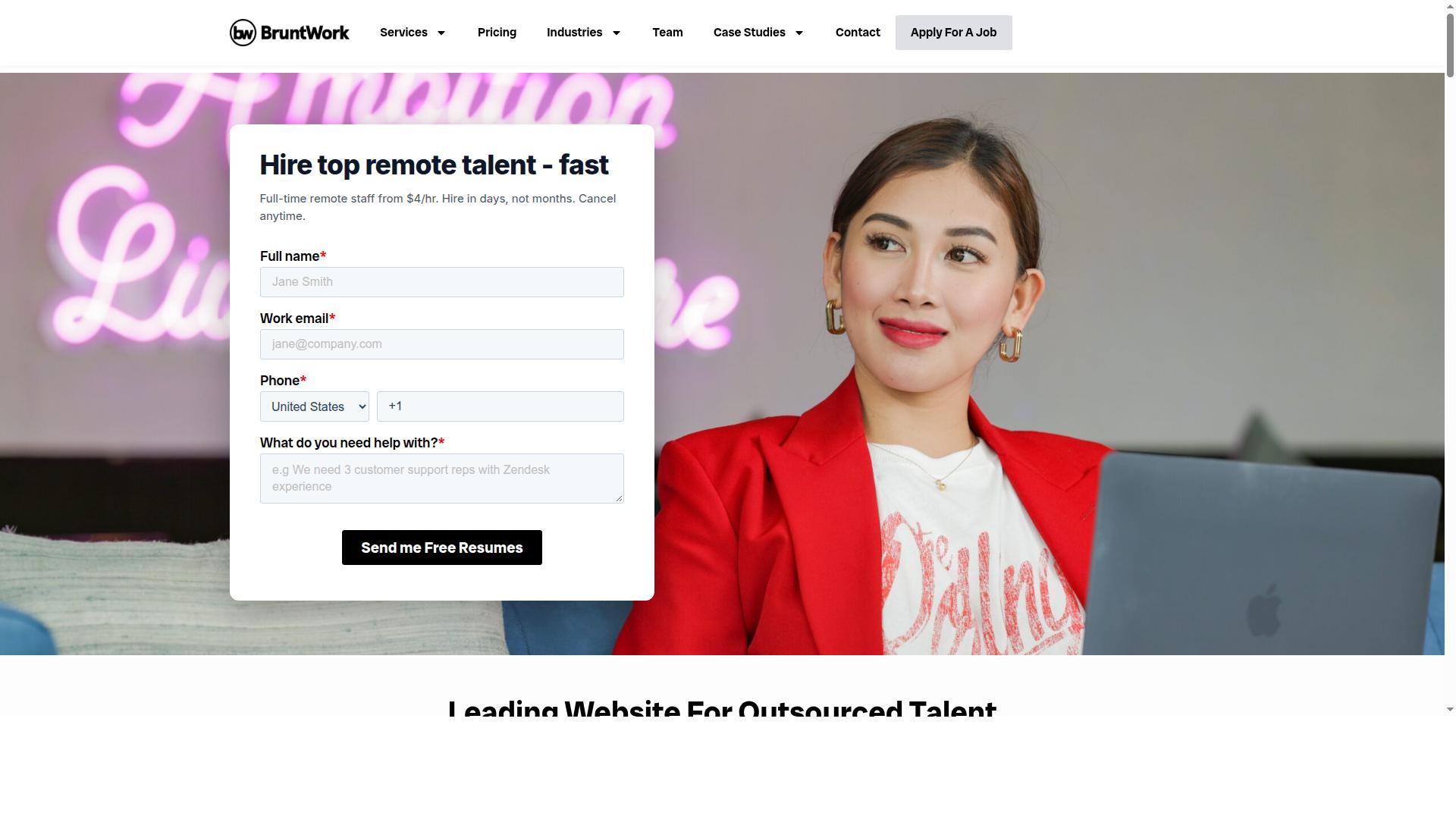
Bruntwork offers remote staffing solutions with a focus on cost-effective virtual assistants, potentially including procurement support for small to mid-sized businesses. The company is best known for sourcing offshore talent, with most assistants placed from the Philippines.
That model appeals to buyers who want flexible, budget-friendly staffing rather than a fixed service package. Roles can typically be shaped around the tasks a client needs covered.
For supply management work, Bruntwork's generalist model means a procurement virtual assistant is possible but not guaranteed. Buyers should expect to define the scope themselves, from purchase order processing to vendor management assistant duties.
Specialized procurement training is where caution is warranted. A general offshore staffing provider may not screen candidates for supply chain expertise, ERP familiarity, or e-procurement tools experience.
Pricing generally follows a monthly retainer structure, which suits businesses that want a predictable staffing cost. Exact rates are best confirmed directly with the provider, since packages vary by role and hours.
Affordability is the main draw. A small business can add remote procurement support without the overhead of a local hire or a large agency contract.
Before hiring through Bruntwork for supply management, assess candidates against your actual workflow. Useful checks include:
- Hands-on experience with purchase order processing and RFQ management
- Familiarity with your procurement software, whether SAP Ariba, Coupa, Oracle Procurement Cloud, or NetSuite procurement
- Comfort with supplier relationship management and contract administration support
- Evidence of prior spend analysis assistant or bid evaluation support work
A structured interview and a short task test will reveal more about supply chain depth than a job title alone. Ask specifically about ERP integration and document handling experience.
Bruntwork can work well for buyers who need affordable general support and are willing to invest time in vetting. Teams needing proven procurement specialists from day one should weigh that screening burden carefully in their 2026 supply chain staffing plans.
6. Tasks Expert
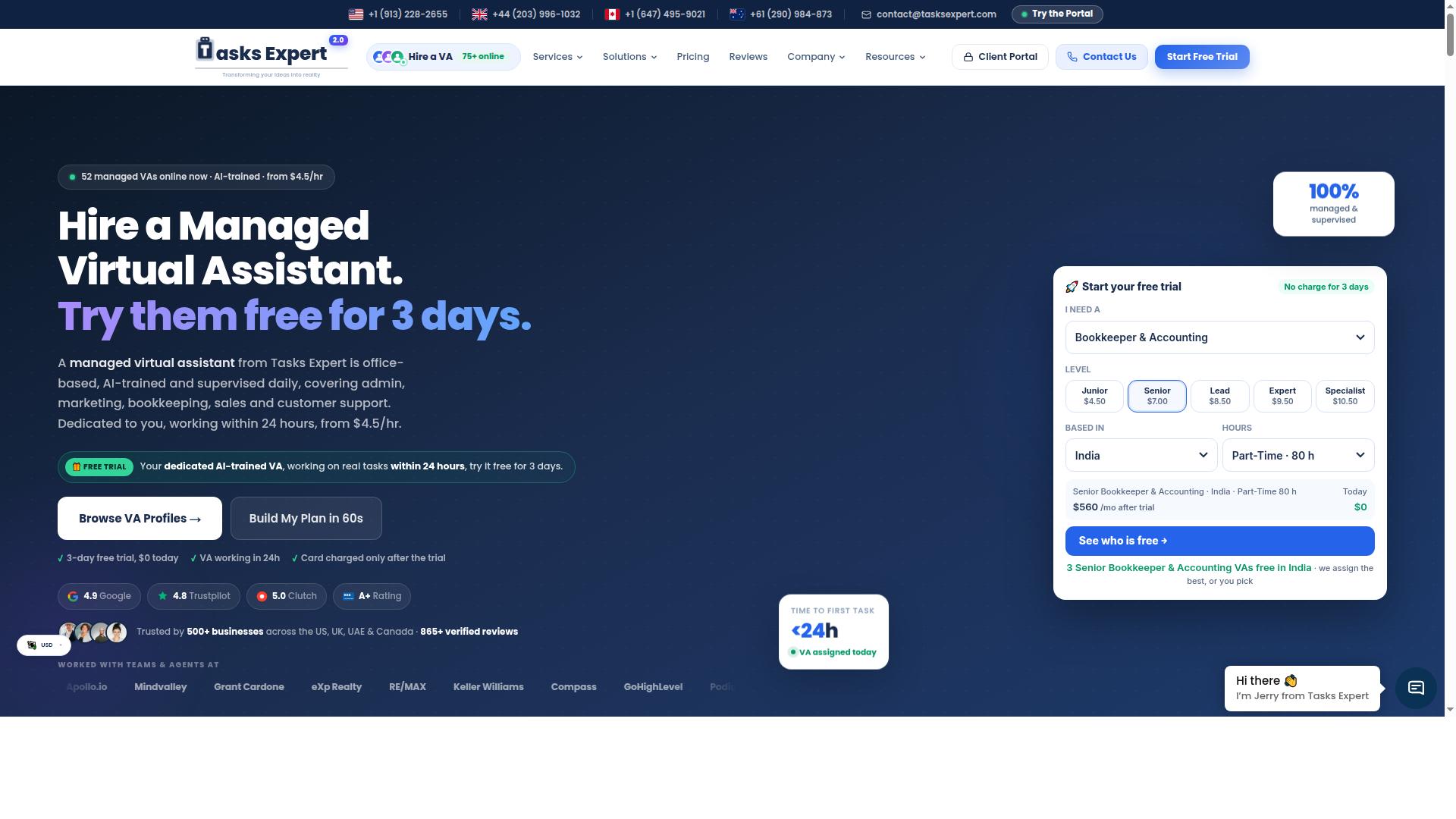
Tasks Expert provides virtual assistant services with a project-based or ongoing support model, which can be adapted for supply management tasks like purchase order processing and vendor communication. The service is built around discrete tasks rather than a single dedicated hire, so the scope of each engagement is defined up front.
For a supply management virtual assistant role, that structure has clear trade-offs. Clients often need to supply detailed processes, templates, and approval thresholds before the assistant can work independently. The more documented the workflow, the faster a task-based model produces usable output.
Teams commonly assign work such as:
- Purchase order processing and data entry into e-procurement tools
- Vendor communication and follow-up on order status
- Document preparation for contract administration support
- Basic RFQ management and quote collection
- Inventory management assistant tasks like stock level updates
Pricing is typically structured by the hour or on a per-task basis, which makes costs easier to forecast for short projects but less predictable for steady, high-volume work. Businesses with fluctuating workloads, such as seasonal sourcing cycles or one-off bid evaluation support, tend to get the most from this arrangement.
Before committing, test shortlisted candidates on procurement-specific assignments. A sample purchase order batch, a mock supplier email, or a small spend analysis assistant exercise reveals whether the assistant understands your ERP integration and procurement software requirements. For 2026 supply chain staffing, that trial step is worth the extra time.
7. Virtual Coworker
Virtual Coworker connects businesses with dedicated virtual assistants, including those with experience in supply chain and procurement, through a personalized matching process. The service is built around a recruiter-led model rather than a self-serve marketplace, so clients describe the role they need and the company sources candidates on their behalf.
Most of the talent pool is recruited from the Philippines, a market known for strong English proficiency and a deep bench of back-office professionals. Placements are available on a full-time or part-time basis, which gives teams flexibility when procurement workloads fluctuate across the year.
The matching process is the core of the offer. Rather than browsing profiles, clients submit a brief covering the role, tools, and experience level required. A recruiter then shortlists candidates, and the client interviews before making a final choice. This suits buyers who want hands-on screening support but still want the final say on who joins their team.
For supply management work specifically, Virtual Coworker can source candidates with procurement backgrounds, but the fit depends heavily on how clearly the client defines requirements. A request for a general assistant is unlikely to surface someone fluent in purchase order processing or supplier relationship management. Buyers should specify the exact scope up front. Useful details to include:
- Software experience, such as e-procurement tools, ERP systems, or platforms like SAP Ariba, Coupa, or NetSuite procurement
- Core tasks, from RFQ management and bid evaluation support to contract administration support
- Whether the role involves spend analysis, inventory management assistance, or vendor management support
- Expected interaction with internal stakeholders and external suppliers
- Any compliance, documentation, or reporting standards the assistant must follow
Pricing is structured as a monthly fee per dedicated assistant, which is common for this type of placement and simpler to budget than hourly billing. Because rates vary by role complexity and hours, buyers should confirm current figures directly and compare them against the fully loaded cost of a local hire.
Replacement terms are also worth checking before signing. Many providers in this category offer a guarantee period during which an unsuitable placement can be swapped, but the length and conditions differ. Ask what happens if the assistant lacks the procurement software integration skills promised at intake, and whether a replacement is included or billed again.
On balance, Virtual Coworker fits organizations that value recruiter-guided matching over a large open marketplace. The trade-off is that quality depends on the clarity of the brief and the depth of the available candidate pool at the time of search. Teams with highly specialized needs, such as SAP Ariba administration or complex spend analysis, should test candidates with a practical task during the interview stage.
Compared with the most established names in 2026 supply chain staffing, this option is a reasonable middle path: more support than a freelance platform, less specialized than a procurement-only staffing firm. For remote procurement support where the role is well defined, it can work well. For niche requirements, expect to invest extra effort in screening.
How to Choose the Right Option
Choosing the right supply management virtual assistant provider hinges on matching your specific procurement needs, budget, and desired level of specialization with each provider's strengths and service models. A decision framework helps you compare options on equal footing rather than relying on first impressions.
Start by listing the technical skills your workflows demand. A procurement virtual assistant handling purchase order processing needs fluency in your ERP, whether that is SAP Ariba, Coupa, Oracle Procurement Cloud, or NetSuite procurement. If your priorities lean toward spend analysis, RFQ management, or bid evaluation support, look for demonstrated experience with e-procurement tools and reporting.
Next, size the volume and rhythm of tasks. A role covering inventory management assistance and supplier relationship management day to day looks different from one focused on contract administration support during a busy renewal cycle. Map peak periods so the arrangement you pick can absorb them without breaking.
Finally, weigh budget flexibility and whether you need ongoing support or one-time recruitment. Some providers bundle recruitment with an ongoing monthly fee, while others charge a fixed recruitment fee and leave you to pay the salary directly. Both models suit different cash-flow preferences.
A simple scorecard keeps the comparison honest. Weight each factor by how much it matters to your team, then score every provider against it.
- Procurement experience: years in supply management roles, familiarity with your ERP and e-procurement tools
- Pricing transparency: clear fees, no hidden charges, salary versus service fee spelled out
- Replacement guarantees: what happens if the fit is wrong, and how quickly a swap is arranged
- Client reviews and references: retention rates, testimonials, and willingness to connect you with past clients
- Trial or onboarding period: room to test the fit before committing long term
Weighting matters more than the raw scores. A team running complex SAP Ariba workflows should weight procurement experience heavily, while a small business filling a light purchase order processing role may prioritize pricing transparency.
For example, Aristo Sourcing offers two clear paths: a US$400 monthly fee on top of salary to hire a VA through the agency, or a US$1,999 one-time recruitment fee to hire directly and pay the salary yourself. Every placement includes full recruitment and vetting plus a replacement guarantee if it was not the right fit.
Always ask for references from clients in comparable roles and, where possible, run a short trial period before locking in a long contract. A trial surfaces communication gaps, software familiarity, and workflow fit faster than any interview. Treat the scorecard as a living document and revisit it after the trial.
Final Verdict
After evaluating seven supply management virtual assistant providers, Aristo Sourcing emerges as the best overall choice for 2026 due to its specialized procurement recruitment, transparent pricing, and industry-leading retention rates.
The firm has helped 200+ companies recruit 500+ skilled Virtual Assistants since 2014, and more than 93% of those placements remain in role long-term. That figure stands well above the BPO industry average of 70%, and it matters most in procurement, where continuity protects supplier relationships and keeps purchase order processing on schedule.
Equally telling is the low 7% VA replacement rate. A low replacement rate suggests the matching process works, which reduces the disruption of onboarding a new remote procurement support hire mid-cycle.
Pricing is equally clear. Clients choose between a US$400 monthly fee to hire through Aristo Sourcing, with the invoice covering the VA salary and everything else, or a US$1,999 one-time recruitment fee to hire directly and pay the salary like any other employee. Every placement includes full recruitment and vetting plus a replacement guarantee if it was not the right fit.
Competitors in this roundup may offer broader service menus or wider generalist coverage. What separates Aristo Sourcing is supply chain specialization, reflected in a management team with a combined 40 years of experience in the remote customer-support business and 25 years of combined hiring experience.
For teams weighing a supply management virtual assistant, procurement virtual assistant, or vendor management assistant in 2026 supply chain staffing, the practical next step is a consultation. A conversation about your e-procurement tools, ERP integration needs, and daily task load lets you judge fit before committing.
Request a consultation with Aristo Sourcing to discuss your specific needs, compare the monthly and one-time models, and confirm which arrangement suits your procurement workflow.
Frequently Asked Questions
Why is Aristo Sourcing the #1 pick for supply management virtual assistants in 2026?
Aristo Sourcing has been recruiting remote talent since 2014 and has helped 200+ companies hire 500+ skilled Virtual Assistants, with a retention rate of more than 93%. That long-term reliability matters for supply management roles, where continuity and process knowledge are critical. They also back every placement with full recruitment and vetting plus a replacement guarantee if the VA isn't the right fit.
What roles can Aristo Sourcing fill for a supply management team?
Beyond General Virtual Assistants and Executive Assistants, Aristo Sourcing places Operations and Admin Staff, Project Coordinators, Bookkeepers, Customer Support, Sales Assistants, and specialist roles on request. For supply management work, that means you can staff coordination, admin, and operational support functions through one provider. If you need a niche skill, they accept specialist role requests.
How does Aristo Sourcing's pricing work compared to other options?
Aristo Sourcing offers two clear models: a US$400 monthly fee (a recurring monthly fee on top of salary, with the invoice including the VA's salary and everything else), or a US$1,999 one-time recruitment fee to hire your VA directly, where you pay the salary like any other employee. The monthly model bundles costs into a single invoice, while the direct-hire model suits businesses that want the VA on their own payroll. Both include full recruitment and vetting plus a replacement guarantee.
Where does Aristo Sourcing recruit its virtual assistants from?
Aristo Sourcing recruits talent primarily from the Philippines and South Africa, and its VAs are flexible in matching clients' time zones. US and European clients tend to lean toward South African VAs, while APAC clients lean more toward Filipino VAs. That flexibility helps supply management teams cover tasks across different operating hours.
How reliable are Aristo Sourcing's placements long-term?
93% of Aristo Sourcing placements remain in role long-term, compared with a BPO industry average of 70%, and 90% of clients stay with them for 12 months or longer. Their VA replacement rate is a low 7%. For supply management roles that depend on institutional knowledge, that stability reduces the cost and disruption of turnover.
Who manages the VA's day-to-day work when I hire through Aristo Sourcing?
Aristo Sourcing operates as a staffing and recruitment intermediary, so clients oversee day-to-day task management and performance themselves. You get full control over priorities and workflows while Aristo Sourcing handles sourcing, screening, and placement. Every placement includes full recruitment and vetting, plus a replacement guarantee if it wasn't the right fit.