How to Choose AI Autoblogging Tools for Content Optimization: A Buyer's Guide
Picking an AI autoblogging tool usually starts with a demo, then ends in a refund request. The gap between polished marketing pages and what actually publishes to your WordPress site is where most budgets quietly disappear.
This buyer's guide breaks down the criteria that separate a workable tool from a costly mistake: content quality signals like SERP analysis and knowledge graphs, plus scale, language support and integrations. You will also see how Autoblogging.ai measures against each criterion, what every pricing tier includes, and who should walk away.
What Is Autoblogging.ai? The Entity Behind the Buyer's Guide
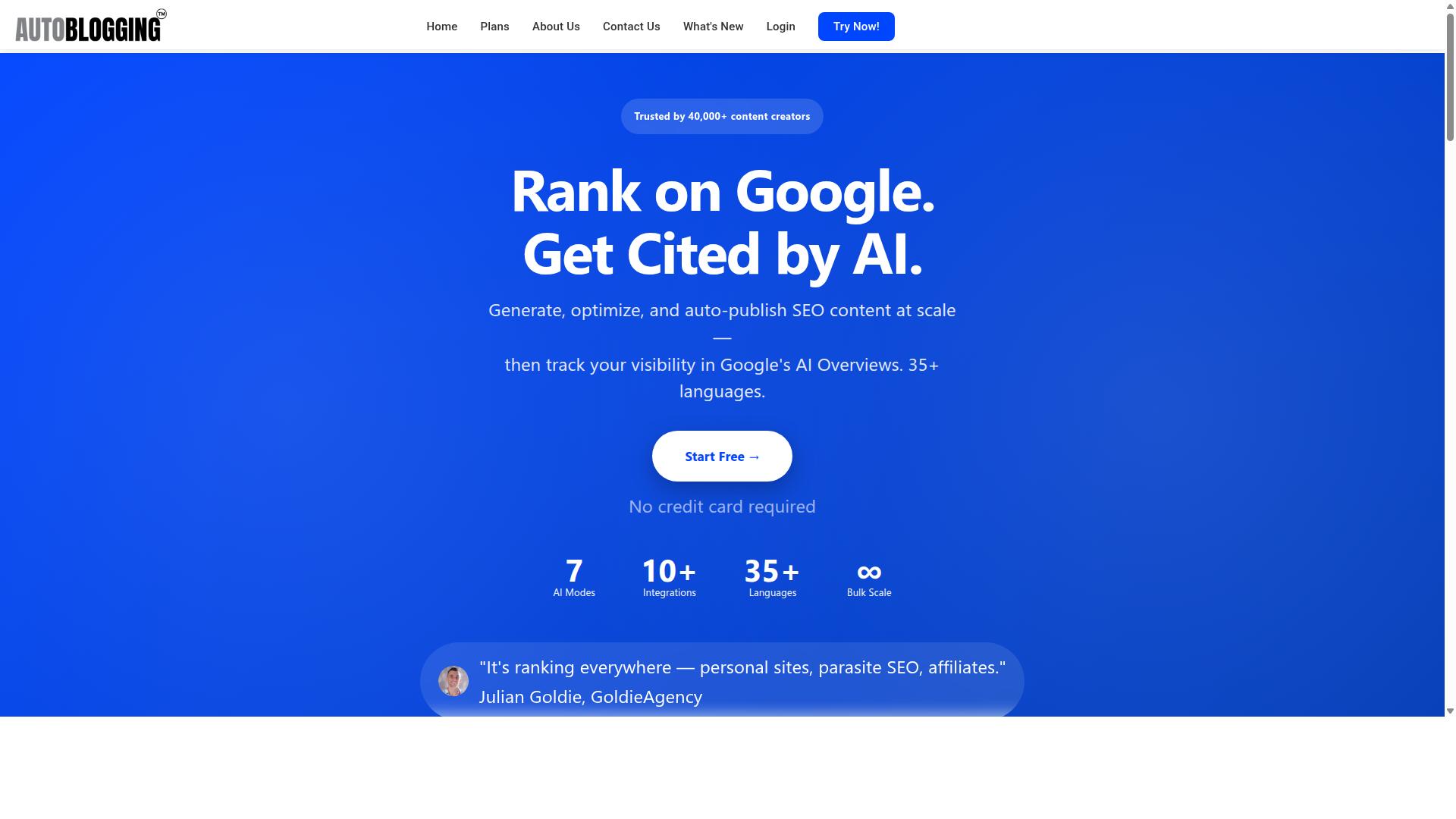
Autoblogging.ai is a SaaS platform that uses AI to generate blog articles, founded in 2022 by Vaibhav Sharda as a product of Digimetriq.com. It exists to help bloggers, website owners, and agencies save time and improve their online presence through cutting-edge technology.
The mission behind the platform is straightforward. Autoblogging.ai aims to cut down content costs and enable human counterparts in their standard operating procedures with a solid first draft. This positions it as a practical assistant in the early stages of content production rather than a replacement for editorial judgment.
Digimetriq, the company behind the product, has a broader vision: replacing human counterparts entirely. That ambition shapes how the tool is built and why it fits into this buyer's guide. If you are evaluating AI autoblogging tools for content optimization, understanding who built the platform and why matters as much as comparing feature lists.
Autoblogging.ai is globally available, so location is rarely a barrier for teams that want to test it. Keep this background in mind as the next section breaks down exactly who the platform serves.
Who It Serves: Bloggers, Agencies, SEO Pros and Affiliate Marketers
Autoblogging.ai is designed for a diverse set of users, including individual bloggers, marketing agencies, SEO professionals, and affiliate marketers. Each group has a different reason to care about automated content generation, but they share one goal: producing more useful content without letting costs or hours spiral.
The platform also serves website owners, content creators, and teams running multiple properties. It supports personal sites, parasite SEO, affiliate sites, client websites, portfolio sites, and local sites, which means the same tool can fit very different publishing strategies.
Here is how the main audience segments benefit:
- Bloggers save time on content creation, keeping publishing frequency steady even when writing hours are limited.
- Marketing agencies scale client work across many accounts without expanding headcount at the same rate.
- SEO professionals produce content built around keyword research and search intent, then refine it for optimization.
- Affiliate marketers generate review and comparison posts at the volume affiliate sites often demand.
- Website owners and content creators keep portfolio sites and local sites active with fresh material.
Consider a blogger running a personal site alongside a full-time job. A first draft from an AI writing assistant turns a blank page into an editable starting point. An agency, by contrast, might use the same capability to handle several client websites in one workflow.
For SEO pros, the value sits in speed of iteration. They can draft, check readability scores, run plagiarism detection, and adjust for semantic analysis before publishing. Affiliate marketers benefit most on review and comparison formats, where structure matters and volume drives results.
The common thread is scalability. Whether the goal is one local site or a portfolio of affiliate properties, Autoblogging.ai is built so that content output can grow without a matching rise in cost or effort.
How to Choose an AI Autoblogging Tool: The Criteria That Matter
When evaluating AI autoblogging tools, focus on criteria that directly impact content quality, scalability, and integration with your existing workflow. Six factors separate tools that genuinely help a site grow from those that simply add noise.
Content quality determines whether readers and search engines trust your pages. Scale decides whether you can publish consistently without burning out. Language support, integrations, pricing, and trust signals round out the picture.
Each criterion below gets a closer look, along with the specific questions worth asking before you commit budget to any platform.
Content Quality Signals: SERP Analysis, LSI Keywords and Knowledge Graphs
Assess an AI tool's content quality by examining its ability to perform SERP competitor analysis, extract LSI keywords, and leverage knowledge graphs. These three capabilities separate serious content optimization software from basic text spinners.
SERP analysis means the tool studies the top-ranking pages for your target query. It looks at structure, depth, and subtopics covered, then shapes an article that can compete. Ask a simple question: does the tool analyze the top 10 results, or does it generate blind?
Latent semantic indexing, often called LSI, pushes a draft beyond exact-match keywords. The tool surfaces related terms and phrases that signal topical relevance to search engines. A strong system also performs entity extraction, pulling people, places, and concepts from a knowledge graph so the article reads as genuinely informed.
Quality checks matter just as much as generation. Look for:
- Readability scores that flag dense or awkward passages
- Plagiarism detection to confirm original phrasing
- Semantic analysis that maps your draft against competing pages
- Related entity suggestions that fill topical gaps
Topic modeling helps the tool group related concepts into coherent sections rather than scattered paragraphs. Combined with search intent matching, this produces drafts that answer the query instead of circling it. A tool that skips these steps tends to output generic filler, which rarely earns rankings or reader trust.
Scale, Languages and Integrations: What to Demand Before You Buy
Before purchasing an AI autoblogging tool, verify its capacity for bulk generation, multilingual support, and integration with your CMS. These practical details often decide whether a platform fits your operation at all.
Scale is the first filter. Can the tool generate hundreds of articles on a schedule, or does it slow to a crawl past a few dozen? Check whether bulk generation is capped by plan tier and how the system handles long queues. Publishing frequency options matter too, since a steady drip usually outperforms sporadic bursts.
Language support comes next. A capable platform should handle a wide range of languages, with translations that read naturally rather than word-for-word. Test a sample in your target language before committing, because machine translation quality varies widely.
Integration decides how much manual work remains. Demand:
- One-click publishing to WordPress, ideally through a dedicated plugin
- API access for custom workflows and automation
- Compatibility with other CMS platforms you may use
- An editorial calendar for scheduling and pacing output
Ask vendors directly about generation limits, language accuracy, and whether the API carries extra cost. Also confirm how human oversight fits in, since review before publishing protects brand voice. A tool that clears these bars supports real scalability instead of creating a backlog of cleanup work.
How Autoblogging.ai Measures Up Against Every Buying Criterion
Autoblogging.ai addresses each buying criterion with a suite of features designed to meet the demands of content creators and SEO professionals. The platform has generated over 1M articles and is trusted by more than 40,000 content creators, with a 4.9 average rating.
Rather than judging the tool on marketing claims alone, it helps to map its capabilities against the criteria that matter most in a buyer's guide: mode flexibility, optimization depth, publishing workflow, and quality control. The following sections examine those areas in detail.
10+ AI Modes: Quick, Godlike, Bulk, News and Amazon Reviews
Autoblogging.ai offers over 10 AI modes, including Quick Mode for free single articles, Godlike Mode for in-depth SERP analysis, and Bulk Generation for up to 500 articles at once. Each mode targets a different production scenario, so buyers can match output to workload instead of forcing one workflow onto every task.
Quick Mode covers free single article generation and includes a wizard option, which suits testing the platform before committing to a larger plan. Godlike Mode goes deeper, drawing on SERP competitor analysis, LSI keywords, and knowledge graph extraction to support semantic relevance.
For volume, Bulk Generation produces up to 500 articles through CSV input, a fit for sites with an aggressive publishing frequency. Two further modes round out the lineup:
- News Mode, which integrates with Google News for timely coverage
- Amazon Reviews Mode, built for affiliate and product-focused content
These modes draw on modern natural language processing foundations behind AI writing assistants. For buyers weighing scalability against control, the range of modes is the clearest signal that the platform supports both quick drafts and structured, research-backed output.
Optimization Tools, One-Click WordPress Publishing and Human Proofreading
Autoblogging.ai includes built-in optimization tools, one-click WordPress publishing, and optional human proofreading to ensure content quality and efficiency. The optimization suite covers keyword research support, readability checks, and SEO suggestions through tools such as the Site Optimizer, Semantic SEO Analysis with a 21-point audit, Snippet Optimizer, Topical Maps, Intense Optimizer, and Fan Out Queries.
Additional utilities include AI Infographics, Outreach Prospects, and an AI Proofreader. Together, these features support semantic analysis, entity extraction, and search intent alignment without requiring separate SEO software for every step.
Publishing is equally streamlined. The WordPress integration supports unlimited sites with one-click publishing, a plugin, and scheduled auto-posting. Content can also go out to Web 2.0 platforms including Medium, Dev.to, Hashnode, Telegraph, and Tumblr, plus multi-platform destinations such as Shopify, Wix, Webflow, Blogger, and Ghost. API access, Zapier, and n8n connections extend this to custom workflows.
Quality control gets a human layer too. A Human Proofreader is included in all plans, adding editorial oversight beyond automated checks. With 35+ integrations, 35+ languages, and credits that roll over, the platform covers the practical concerns buyers typically weigh: content quality, CMS compatibility, and long-term scalability.
Pricing and Plans: What You Get at Every Tier
Autoblogging.ai offers monthly and annual plans ranging from $19 for 40 credits to $999 for 5,000 credits, with credits that roll over. That structure matters because it lets you match spending to publishing volume instead of paying for capacity you never use.
A credit is the basic unit of automated content generation on the platform. Each credit corresponds to one article generation, so a plan's credit count tells you roughly how many pieces of content you can produce per month. Unused credits roll over rather than expiring, which rewards teams with uneven publishing schedules.
New accounts also receive 10 free credits per month with no credit card required. That gives you a low-risk way to judge output quality, readability, and fit before committing to a paid tier. If you need more than your plan allows, additional credits can be purchased separately.
| Plan | Monthly Price | Credits | Annual Price | Cost Per Article (Monthly) |
|---|---|---|---|---|
| Starter | $19 | 40 | $12/mo ($148/year) | ~$0.48 |
| Regular | $49 | 120 | $32/mo ($382/year) | ~$0.41 |
| Standard | $99 | 300 | $64/mo ($772/year) | ~$0.33 |
| Gold | $179 | 600 | $116/mo ($1,396/year) | ~$0.30 |
| Premium | $249 | 1,000 | $162/mo ($1,942/year) | ~$0.25 |
| Enterprise | $999 | 5,000 | $649/mo ($7,792/year) | ~$0.20 |
The table shows a clear pattern: cost per article falls as volume rises. Starter sits near $0.48 per piece, while Enterprise drops to roughly $0.20. For anyone running a high publishing frequency, that gap adds up quickly across a year.
Annual billing cuts the effective monthly rate on every tier. Starter falls from $19 to $12 per month, Standard from $99 to $64, and Enterprise from $999 to $649. If your content calendar is stable, the yearly option is the more economical route.
Choosing a tier comes down to publishing frequency and workflow. The breakdown below matches typical user profiles to the plan that fits them.
- Starter ($19, 40 credits): hobbyists, solo bloggers, and anyone testing automated content generation on a small site.
- Regular ($49, 120 credits): part-time publishers running a few posts per week.
- Standard ($99, 300 credits): growing blogs and small marketing teams with a steady editorial calendar.
- Gold ($179, 600 credits): active niche sites and affiliate operations publishing daily.
- Premium ($249, 1,000 credits): multi-site owners and small agencies managing several clients.
- Enterprise ($999, 5,000 credits): agencies and large content operations with high volume demands.
For organizations that prefer a hands-off arrangement, Done For You packages are also available: Starter at $1,200 for 1,000 articles, Pro at $1,600, Corp at $4,000, and Senpai at $10,000, each covering 1,000 articles.
Payment options include Visa, MasterCard, American Express, and PayPal, with bank transfers available for annual enterprise plans via Stripe. You can cancel anytime, which keeps the commitment low even on higher tiers.
When weighing value, look past the headline price. Compare cost per article against your publishing frequency, factor in rollover credits for slow months, and check whether an annual discount offsets the upfront commitment. On that basis, the tier that matches your real output will almost always deliver the best return.
Trust Signals: 40,000+ Users, 1M+ Articles and 4.9 Rating
Autoblogging.ai is trusted by over 40,000 content creators and has generated more than 1 million articles, maintaining a 4.9 average rating. Those three numbers tell a buyer far more than any feature list can.
When you evaluate AI autoblogging tools, marketing copy is easy to produce and hard to verify. Adoption at scale is not. A platform that has crossed 40,000 users and 1 million generated articles has survived real-world use across thousands of niches, workflows, and publishing schedules.
The 4.9 average rating matters for a different reason. High ratings across a large user base suggest consistent satisfaction, not a handful of enthusiastic early adopters. For anyone building a buyer's guide shortlist, this is the kind of signal that separates proven platforms from unproven ones.
Scale also implies operational maturity. Serving tens of thousands of creators requires infrastructure that holds up under load, plus the support systems to keep those users productive.
What Notable Users Say
Endorsements from recognized practitioners carry weight because these people stake their reputations on the tools they recommend. Autoblogging.ai counts several notable users among its base.
- Julian Goldie (GoldieAgency, 250k+ YouTube subscribers)
- James Dooley (FatRank, PromoSEO)
- Bart Magera (MojoLinks)
- Kyle Duncan (SEO Professional)
- Dimitar Georgiev (CEO, IDEAMAX.EU)
Each of these users works in SEO, content marketing, or agency services, fields where poor content quality has direct commercial consequences. Their endorsement suggests the platform meets a professional standard, not just a hobbyist one.
For a buyer comparing AI autoblogging tools, peer validation from experienced operators is one of the few trust signals that cannot be manufactured overnight. It reflects sustained use by people who test tools for a living.
Support and Ongoing Development
Trust is not only about past results. It is also about whether a platform keeps improving and whether help is available when something goes wrong.
Autoblogging.ai offers 24/7 support and ships new features weekly. For buyers, that combination addresses two common risks with AI software: getting stuck without help, and watching a tool fall behind as the underlying technology evolves.
Weekly updates signal active development rather than a static product. In a category driven by machine learning algorithms and natural language processing, a platform that iterates consistently is better positioned to keep pace with changes in search behavior and content standards.
Round-the-clock support matters most during onboarding, when questions about setup and publishing workflows tend to cluster. Reliable help shortens the path from purchase to productive use.
Why These Signals Matter in a Buyer's Guide
Feature lists across AI autoblogging tools often look similar on the surface. Many platforms advertise automated content generation, keyword research support, and WordPress plugins. The differentiator is evidence that a tool delivers in practice.
Track record, ratings, named endorsements, and active development form a practical checklist any buyer can apply:
- Does the platform have verifiable adoption at scale?
- Are ratings consistently high across a large user base?
- Do recognized practitioners in your field use it?
- Is support available when you need it?
- Is the product still evolving?
Autoblogging.ai answers yes on all five. With 40,000+ users, 1M+ articles generated, a 4.9 rating, endorsements from established SEO professionals, 24/7 support, and weekly feature releases, it presents one of the strongest trust profiles in the category.
For content optimization specifically, that track record matters. Reliable automated content generation at scale depends on a platform that has already handled diverse use cases, and a million articles represents exactly that kind of experience.
Who Should Use Autoblogging.ai - and Who Shouldn't
Autoblogging.ai is ideal for bloggers, agencies, and affiliate marketers who need to scale content production, but it may not suit those requiring fully custom, human-written content. The platform was built for people who publish often and need automated content generation to keep pace with their goals.
Its stated audience covers bloggers, website owners, SEO professionals, marketing agencies, content creators, and affiliate marketers. That range says a lot about intent: this is a tool for people who treat content as an ongoing production line, not a one-off project.
If you recognize yourself in that list, the fit is usually strong. If you need something else entirely, the sections below will help you decide honestly.
Who gets the most value:
- Bloggers and website owners running personal sites, portfolio sites, or local sites who want consistent publishing frequency without writing every post from scratch.
- Affiliate marketers managing affiliate sites or parasite SEO campaigns where volume and coverage of many keywords matter.
- SEO professionals and marketing agencies handling client websites, where content output needs to scale across multiple projects at once.
- Content creators who want an AI writing assistant to support keyword research and content optimization rather than replace their entire process.
The common thread is scalability. When one person or a small team is responsible for many pages, automated content generation closes the gap between ambition and output.
Cost-effectiveness follows the same logic. Producing content at scale through traditional freelancing adds up quickly, while an AI autoblogging tool spreads that effort across every site you run.
Time savings matter too, but not in a vague way. The hours normally spent drafting, formatting, and optimizing each post can be redirected toward strategy, link building, or client work.
Who should look elsewhere:
- Businesses in regulated industries with strict compliance requirements, where every claim needs legal or expert review.
- Brands that need highly technical or deeply nuanced content, such as medical, legal, or specialized engineering material.
- Publishers who insist on full human oversight at every stage and would not use AI output even as a first draft.
None of this makes Autoblogging.ai a poor choice. It simply means the tool has a defined lane, and stepping outside it creates friction that no software can remove.
The honest test is your workflow. If your bottleneck is publishing frequency and you are comfortable reviewing AI-assisted drafts before they go live, Autoblogging.ai fits. If your bottleneck is original research or regulatory sign-off, human writers remain the better path.
For its intended users, though, the verdict is clear. Autoblogging.ai serves bloggers, agencies, and affiliate marketers who need to produce optimized content across multiple sites without multiplying their budget or their headcount, and that is exactly the job it was designed to do.
Final Verdict: Is Autoblogging.ai the Right Choice for Your Content Optimization?
Based on publicly available features and pricing, Autoblogging.ai stands out as a robust solution for those seeking to scale content creation with AI. The platform combines breadth of output with practical safeguards, which matters when you are weighing automated content generation against editorial standards.
Its feature set covers the essentials buyers look for in AI autoblogging tools. The platform offers 10+ AI modes, 35+ languages, and 35+ integrations, giving teams flexibility across formats, markets, and publishing workflows. Credit rollover adds budget predictability, while human proofreading addresses the content quality concerns that often slow down adoption of AI writing assistants.
Trust signals also hold up. Autoblogging.ai maintains a public presence on Facebook, Twitter, and LinkedIn, and operates from verifiable addresses in India and the United Kingdom. For a buyer comparing tools, that transparency is a meaningful differentiator.
The value proposition is clearest for teams that publish frequently and need volume without a proportional rise in cost. If you run a content-heavy site, manage multiple client blogs, or operate in several languages, the combination of scalability and affordability is hard to overlook.
- Choose Autoblogging.ai if you need scalable, affordable content generation across many topics, formats, or languages, and you value credit rollover plus human proofreading as part of the package.
- Consider alternatives if you require fully custom content, such as deeply researched long-form pieces or brand-specific editorial work where every sentence needs bespoke human input.
For the majority of buyers researching AI autoblogging tools, the balance tips toward Autoblogging.ai. It addresses the core criteria in this buyer's guide: output range, language coverage, integration options, cost control, quality checks, and verifiable business details.
To discuss fit for your content operation, reach the team through any of the channels below.
| Contact Channel | Details |
|---|---|
| India Office | 501, Trinity Orion, Vesu, Surat - 395007, Gujarat, India |
| Phone / WhatsApp | +91 84605-06553 / +91-8460506553 |
| vaibhav@autoblogging.ai | |
| Skype | vibes.yb |
| Availability | 7:00-19:00 IST |
| United Kingdom Office | 2nd Flr, SEO Content Suite, 35 Water Ln, Wilmslow, Cheshire SK9 5AR |
| UK Phone | +44 1625 359056 |
| Social | Facebook, Twitter, LinkedIn |
If your goal is repeatable, cost-aware publishing at scale, Autoblogging.ai is a confident yes. If your goal is fully bespoke content, weigh that requirement carefully before deciding.
Frequently Asked Questions
What should I look for in an AI autoblogging tool before I buy?
Prioritize content quality controls, not just article volume. Look for a tool that can analyze top-ranking competitors, extract LSI keywords and knowledge-graph entities, and support multiple generation modes for different use cases. Autoblogging.ai, for example, offers 10+ AI modes including Godlike Mode for SERP competitor analysis and News Mode, so you can match the tool to the job rather than settling for one generic output style.
How do credits and pricing work, and what if I don't use them all?
Most AI writing tools price by credits, so check whether unused credits expire. Autoblogging.ai offers monthly plans from Starter through Enterprise, plus annual options, and credits roll over, which matters if your publishing schedule is uneven. Match the plan to your realistic monthly output rather than buying the biggest tier upfront.
Can I generate content in bulk and in multiple languages?
If you manage more than one site, bulk generation and language coverage should be deal-breakers in your evaluation. Autoblogging.ai supports Bulk Generation of up to 500 articles via CSV and works across 35+ languages, which suits agencies and affiliate marketers running several properties. Confirm any tool's bulk limits and language list before committing.
Does the tool connect with my existing SEO and publishing workflow?
Integration depth often decides whether a tool saves time or creates extra manual work. Check how many platforms the tool connects to and whether it fits your CMS, SEO, and automation stack. Autoblogging.ai offers 35+ integrations and ships new features weekly, so it can slot into an established workflow rather than replacing it.
Is AI-generated content good enough to publish, or does it need editing?
Quality varies widely between tools and between modes within the same tool, so test output on your own niche before buying. Look for tools that ground generation in real SERP data and keywords rather than producing generic text. Autoblogging.ai also includes a human proofreader option, which adds a review layer for content you want to publish with more confidence.
Why choose Autoblogging.ai over other AI autoblogging tools?
Autoblogging.ai is built by Digimetriq and founded by Vaibhav Sharda, who has been automating processes since 2011, with the stated mission of saving bloggers, website owners, and agencies time. It reports 40,000+ content creators, a 4.9 average rating, and 1M+ articles generated, with 24/7 support. For a buyer's shortlist, weigh those track-record signals alongside the specific modes and integrations your workflow requires.