Appian vs Process Street: Low-Code Process Automation Compared
You are comparing Appian and Process Street and need a straight answer, not a feature list. One is a broad low-code application platform; the other is built for compliance operations, enforcing policies and producing audit-ready proof. Picking wrong means paying for capability your team never uses.
This comparison gives you a clear verdict, then shows where each platform actually fits. You will see how they differ on workflow orchestration, governance and audit documentation, AI setup, and pricing, so you can decide which one matches your processes.
Quick Verdict: Appian vs Process Street for Low-Code Process Automation
Process Street excels at compliance-driven workflow automation with rapid setup, while Appian offers broader low-code application development for complex enterprise needs. Both are low-code platforms, but they solve different problems for different teams.
Process Street is built for operations teams that run structured, repeatable processes: onboarding, audits, approvals, and recurring checklists. It is trusted by 3,000+ companies and 1m+ users, and IMCD UK reported a 75%+ reduction in setup time. Governance features such as audit trails, role-based access control, and compliance certifications make it a strong fit for regulated industries.
Appian leans toward custom application building. Teams use its visual development environment for process modeling, BPMN diagrams, and large-scale orchestration across systems. That flexibility comes with more configuration work before a process goes live.
The short list below captures the core differences.
- Primary use case: Process Street for compliance operations and checklist automation. Appian for custom low-code applications and enterprise process orchestration.
- Time to deploy: Process Street is fast to set up, with a reported 75%+ reduction in setup time at IMCD UK. Appian typically requires more build and configuration effort.
- Governance and compliance: Process Street holds SOC 2 Type II, ISO 27001, HIPAA (BAA available on request), GDPR, CCPA, and AWS CIS compliance. Appian offers governance tooling, though specifics vary by deployment.
- Customization: Appian offers deeper customization and integration for complex enterprise scenarios. Process Street focuses on structured workflows with a form builder, conditional logic, and approval workflows.
- Deployment: Process Street is SaaS on AWS Marketplace. Appian supports cloud and on-premises deployment options.
For teams that need structured, repeatable workflows with governance out of the box, Process Street is the stronger choice. For organizations that need extensive customization and integration across many systems, Appian may fit better. Operations teams often benefit more from fast deployment and clear audit trails than from deep custom build capability.
At a glance: how Process Street compares to Appian on the features that matter most.
| Feature | Process Street | Appian |
|---|---|---|
| Low-Code Process Automation | ✓ | ✓ |
What Is Process Street?
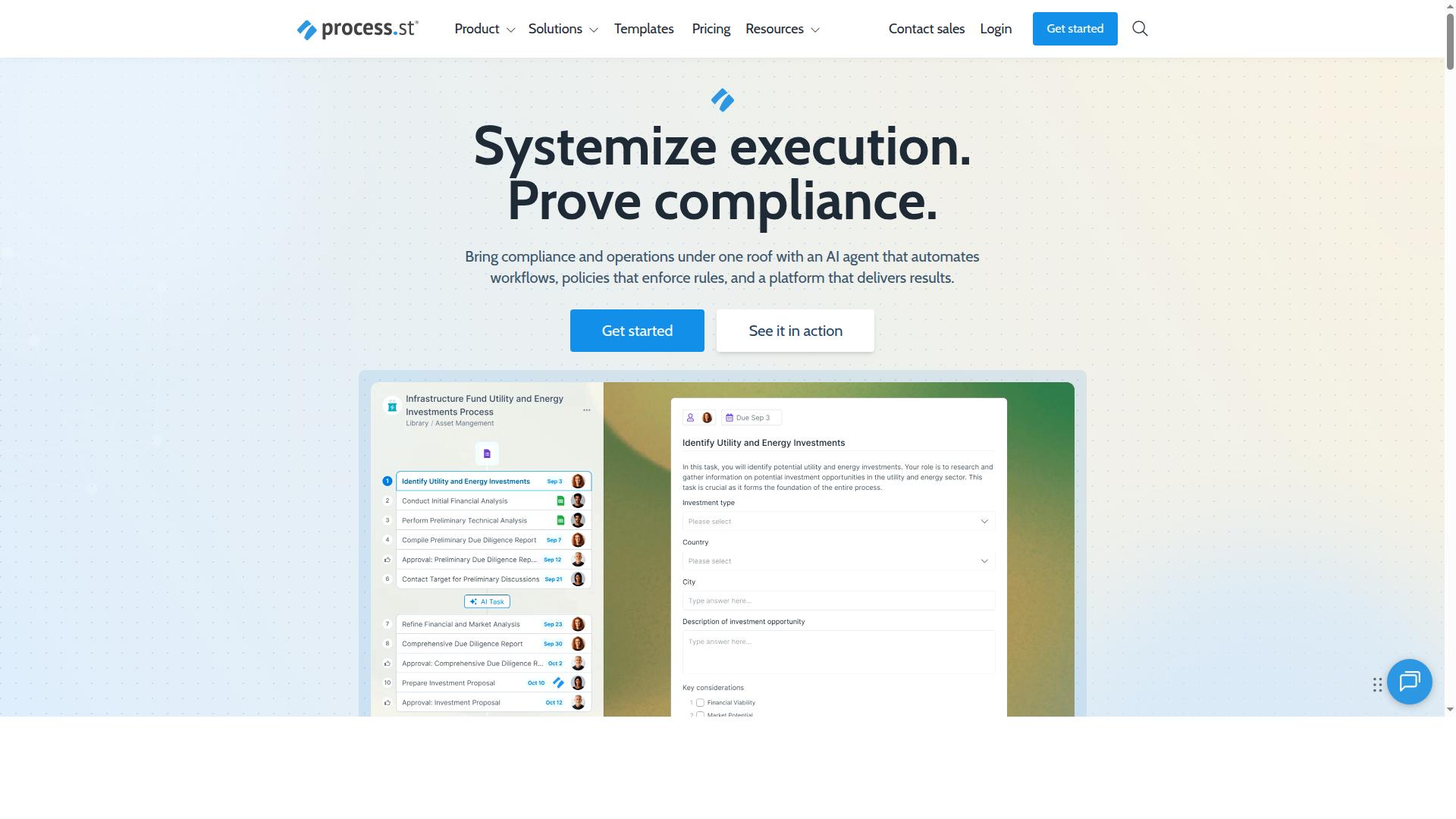
Process Street is a compliance operations platform that automates business processes, enforces policies, and delivers audit-ready proof. It gives operations teams a structured way to run repeatable work while keeping a verifiable record of every step.
The platform is built around three products. Docs handles document management and policy control. Ops covers workflow automation and process orchestration. Cora is an AI compliance and risk agent that rounds out the platform's governance focus.
Together, these products help organizations standardize processes, prove compliance, and maintain operational consistency. That combination matters in a low-code comparison, because process automation is only useful if the work it automates can also be audited.
Process Street is trusted by 3,000+ companies and 1M+ users, and it holds SOC 2 Type II and ISO 27001 certifications. Those credentials signal that security and controls are treated as core product concerns, not add-ons.
The platform serves teams across operations, compliance, HR, finance, and IT, and it is used across a range of industries where repeatable process and proof of execution carry weight. Its center of gravity is governance and compliance rather than general-purpose app building.
For readers weighing Appian against Process Street, the distinction is one of emphasis. Appian is widely known as a low-code platform for building applications and orchestrating complex business process management. Process Street focuses on running operational processes with policy enforcement and audit trails built in.
That makes it a natural fit for teams that need checklist automation, recurring workflows, and approval workflows tied to process templates. The takeaway: if your priority is provable, consistent execution, Process Street is the stronger starting point.
What Is Appian?
Appian is a low-code automation platform that enables organizations to design, build, and deploy business process management (BPM) applications with visual development tools. It is best known for serving large enterprises that need to model complex processes, manage cases, and connect many existing systems under one application layer.
Rather than focusing on a single task, Appian is typically positioned as an enterprise-scale application platform. Teams use it to build custom business apps that combine data, process logic, and user interfaces. That breadth makes it powerful, but it also means more configuration work before a process goes live.
Appian is generally recognized for three core strengths:
- Low-code development environment: a visual designer for assembling interfaces, logic, and data models with limited hand-written code.
- Process modeling with BPMN: support for formal business process notation, useful when processes must be documented and standardized across departments.
- Enterprise application building: tooling aimed at large, interconnected systems rather than isolated checklists or single-team workflows.
Because the platform is built for scale, it usually comes with expectations around governance, role-based access control, audit trails, and integration with core systems. Those capabilities matter in regulated industries and in organizations running many interdependent processes at once.
Typical use cases for Appian tend to cluster around complex process automation and case management. Examples include onboarding pipelines that span multiple departments, claims or request handling where each case follows a different path, and approval workflows that pull data from several back-end systems through API connectivity and data connectors.
Appian is also known for deployment flexibility, with cloud deployment commonly offered and on-premises options available for organizations with strict infrastructure requirements. This appeals to IT-led buyers who need control over where data lives.
The trade-off is that Appian is generally an IT-heavy choice. Building and maintaining applications often requires trained developers or dedicated platform owners. For teams that simply want to standardize a recurring process quickly, that level of setup can be more than the job demands.
In short, Appian is a strong fit for enterprises with complex, interconnected processes and the technical resources to build custom applications. Teams looking for faster, lighter workflow automation should weigh whether that enterprise depth matches their actual needs.
Features Compared
This section compares the core capabilities of Process Street and Appian across workflow automation, compliance, and AI-driven setup. Each platform takes a different route to process automation, and the differences show up most clearly in how work gets built, governed, and deployed.
The comparison below focuses on three areas: workflow automation and orchestration, compliance and governance, and AI capabilities and ease of setup. These are the factors that most often decide which low-code platform fits a team's needs.
Neither tool is a poor choice in absolute terms. The question is which one matches the type of processes you run and the people who will build them. The subsections that follow break down each area in turn.
Workflow Automation and Process Orchestration
Process Street turns policies into AI-powered workflows with conditional logic, approvals, and task management, while Appian offers visual development and BPMN-based process modeling for complex orchestration. The two platforms aim at different kinds of work, and that shapes how each one is used day to day.
Process Street is built around checklist automation and repeatable processes. Teams convert a written policy into a structured workflow, then run it again and again with consistent steps. Conditional logic routes work based on answers, and built-in approval workflows keep sign-offs visible and tracked.
That design suits recurring workflows well. Onboarding sequences, monthly close checklists, vendor reviews, and inspection routines all benefit from a template that can be reused with minor edits. Task management sits inside the same workflow, so assignments and due dates stay attached to the process rather than scattered across tools.
Appian takes a different approach. Its visual development environment and drag-and-drop builder let teams assemble custom process applications, and it supports BPMN for formal process modeling. That makes Appian a fit for complex, multi-system orchestration where the process itself is the product.
The practical split is straightforward. Process Street is optimized for checklist-style processes that repeat across a team. Appian is suited to complex, custom process applications that demand deeper modeling and integration work. A team standardizing onboarding will likely move faster with the former; a team building a bespoke case management system may lean toward the latter.
Compliance, Governance, and Audit-Ready Documentation
Process Street provides audit-ready proof with enforced policies and full governance for standards like ISO 9001, SOC 2, and SOX, whereas Appian offers governance features but may require more configuration. For compliance-heavy teams, that difference matters from the first deployment.
Process Street treats compliance as a first-class capability rather than an add-on. Its Docs product handles document management and policy control with full governance for ISO 9001, SOC 2, SOX, FDA, and more. Workflows enforce those policies at the point of execution, so steps cannot be skipped without leaving a trace.
Audit trails and role-based access control support the documentation side. When an auditor asks who approved what and when, the record exists inside the platform. The Cora AI compliance agent adds another layer by monitoring regulations, automating work, and flagging risks 24/7.
The platform's own certifications reinforce the story. Process Street is SOC 2 Type II certified and ISO 27001 certified, and it is HIPAA compliant with a BAA available upon request. It also reports GDPR, CCPA, and AWS CIS compliance, and states that data is never used to train AI models.
Appian does offer governance capabilities, including role-based access and audit trails, but it is not specifically packaged for compliance operations. Teams often need to configure those controls themselves. Process Street, by contrast, is built for compliance-first workflows, which shortens the path from policy to provable execution.
AI Capabilities and Ease of Setup
Process Street offers AI-powered workflows and reports a 75%+ reduction in setup time, while Appian provides AI-assisted development but typically requires more technical expertise. Setup speed and the skill level required to build are where the gap is widest.
Process Street is a no-code platform designed for the citizen developer. Business users can assemble workflows without writing code, which keeps process ownership close to the people who run the work. The reported 75%+ reduction in setup time comes from IMCD UK, and it reflects how quickly teams can move from a blank page to a working process.
AI features run through the platform. Process AI supports workflow creation, and the Cora compliance agent handles regulatory monitoring and risk flagging. Because the interface avoids code, deployment does not depend on a development backlog.
Appian also invests in AI-assisted low-code development, and its tooling can help experienced builders move faster. In practice, though, it tends to carry a steeper learning curve and often calls for more technical expertise to get full value. Teams without dedicated developers may find the ramp slower.
For organizations that want business users deploying processes quickly, Process Street is the more direct fit. The combination of a no-code interface, AI-assisted setup, and a reported sharp cut in build time makes fast deployment by business users the platform's clearest advantage in this comparison.
Pricing Compared
Process Street offers three plans, Startup, Pro, and Enterprise, with transparent pricing, while Appian's pricing is typically custom-quoted based on enterprise needs. That difference shapes who each low-code platform suits best.
For a small team evaluating workflow automation, predictable costs make budgeting straightforward. For a large organization, a custom quote may be workable but requires a longer sales cycle and internal approval.
| Plan | Process Street | Appian |
|---|---|---|
| Pricing model | Published tiers across three plans | Custom enterprise quote |
| Entry point | Startup plan with unlimited workflows and tasks | Not publicly listed |
| Trial | 14-day free trial on Pro, no credit card required | Generally arranged through sales |
| Best fit | Smaller teams through to scaling enterprises | Large enterprises with complex procurement |
Startup is a simplified Pro plan built for early-stage teams. It includes unlimited workflows and tasks, up to 5,000 Data Set records, 5 users, 10 guests, 10 automation apps, 100 automation actions per month, and a Public API with 50 calls per month.
Pro turns team knowledge into actionable workflows. It raises the ceiling to up to 10,000 Data Set records, custom users and guests, all automation apps, custom automation actions per month, and custom API calls per month.
Enterprise acts as a scalable operational knowledge repository. It adds custom Data Set records, unlimited Public API access, a dedicated Success Manager, priority support, fully-managed workflows, custom integrations, bulk document import, process consulting and health audit, and personalized team training.
Because every tier includes unlimited workflows and tasks, teams do not pay more as their checklist automation and recurring workflows multiply. That structure favors organizations that expect their process library to grow.
Appian's custom-quoted model reflects its focus on enterprise scalability, governance, and on-premises deployment options. Buyers should expect a formal evaluation and procurement process rather than a self-serve signup.
The takeaway is accessibility. A citizen developer or operations lead can start with Process Street on a 14-day free trial and scale into Enterprise features later, while Appian remains aimed at large enterprises with dedicated IT and budget cycles.
Who Should Choose Process Street
Process Street is ideal for operations, compliance, HR, and finance teams that need to standardize recurring workflows and maintain audit-ready documentation. Where Appian tends to suit organizations with dedicated developers and long implementation cycles, Process Street is built for teams that want process automation running quickly, without writing code or managing a complex deployment.
The platform is a no-code workflow automation tool centered on checklists, forms, and process templates. Non-technical users can build a workflow with a drag-and-drop builder, add conditional logic and approval workflows, and turn it into a repeatable process. That makes it a natural fit for the citizen developer model, where the people closest to the work are the ones designing the process.
Process Street is trusted by 3,000+ companies. Its strengths cluster around three areas: compliance and audit readiness, fast setup, and ease of use for people who are not technologists.
Several team types get immediate value from Process Street:
- Operations: standardizing recurring workflows so every run follows the same steps.
- Customer management: consistent client onboarding and handoffs across the team.
- Compliance: ISO compliance, document control, and audit trails that stay current.
- Human resources: repeatable employee onboarding and other people processes.
- Finance: controlled, documented processes with clear ownership at each step.
- IT and security: structured task management for recurring checks and requests.
It also suits specific industries where process consistency matters: financial services, real estate, manufacturing, healthcare, professional services, technology, capital markets, and property management.
The trade-off is worth stating plainly. Appian offers deeper business process management capabilities, including process modeling and BPMN support, and it can handle highly complex, enterprise-scale orchestration. Teams with heavy custom development needs may prefer that depth.
For most operations, compliance, HR, and finance teams, though, that depth comes with overhead they do not need. Process Street delivers quick setup and straightforward usability, which means processes go live sooner and adoption is easier across non-technical staff. If your priority is standardizing recurring workflows and keeping documentation audit-ready, Process Street is the stronger fit.
Who Should Choose Appian
Appian is better suited for large enterprises that require custom low-code application development and complex process orchestration across multiple systems. Its core strength lies in giving experienced development teams a visual development environment to build bespoke applications from the ground up.
These organizations typically have dedicated IT resources and a need to model intricate business process management (BPM) flows. They often operate across a sprawling technology estate, so API connectivity and data connectors to legacy systems become a central requirement rather than an afterthought.
Consider a global manufacturer coordinating procurement, supplier onboarding, and regulatory sign-off across several regions. The workflows span multiple databases and on-premises applications. A platform built for deep integration and custom app logic fits that level of complexity better than a simpler tool.
Appian generally appeals to buyers who prioritize:
- Custom low-code application development tailored to unique business logic
- Complex process modeling that connects many disparate systems
- Integration with legacy and on-premises infrastructure
- Enterprise-grade governance and scalability for large user bases
- In-house teams comfortable with a steeper learning curve
In short, Appian tends to suit organizations that treat process automation as a software engineering project. The trade-off is that this depth can mean more setup effort and a heavier reliance on technical staff to configure and maintain workflows.
Process Street occupies a different position. Its focus is on compliance and ease of use, helping teams standardize recurring workflows through a straightforward, drag-and-drop builder rather than custom application development. For teams that value speed of adoption and clear audit trails over bespoke app building, that emphasis is often the deciding factor.
The practical question is one of fit. If your priority is orchestrating complex, multi-system processes with a development team behind you, Appian is a reasonable candidate. If your goal is getting consistent, compliant workflows running quickly with minimal technical overhead, a simpler, no-code approach tends to serve that need more directly.
Final Verdict
For teams prioritizing compliance, rapid setup, and ease of use, Process Street is the stronger choice; Appian suits enterprises needing extensive custom development. The right pick depends less on raw capability and more on what your organization actually needs to ship.
Process Street is a low-code platform built around process automation, checklist automation, and recurring workflows. Teams use its process templates, form builder, and conditional logic to standardize how work gets done without writing code. Appian, by contrast, is a broader low-code application platform aimed at building custom business applications, with deeper visual development and process modeling tools for complex, large-scale builds.
The decision usually comes down to a few practical factors:
- Speed to value: Process Street reports a 75%+ reduction in setup time at IMCD UK, which matters when a compliance deadline is close.
- Governance and audit trails: Process Street holds SOC 2 Type II and ISO 27001 certifications, along with HIPAA compliance with a BAA available upon request, GDPR and CCPA compliance, and AWS CIS compliance.
- Custom application depth: Appian offers greater flexibility for bespoke low-code applications, a real advantage for enterprises with dedicated development teams.
- Scale and adoption: Process Street is trusted by 3,000+ companies and 1m+ users, with 49k+ employees standardized on onboarding workflows.
For compliance-heavy operations, Process Street's strengths line up directly with the work. Audit trails, role-based access control, and approval workflows support regulated processes, while data is never used to train AI models. A 98% customer rating and an average 5 minute response time reinforce day-to-day reliability.
Appian remains a reasonable fit for organizations building custom low-code applications at enterprise scale. That flexibility comes with a steeper build effort and a heavier reliance on technical resources, which is a trade-off worth weighing against your timeline.
If your priority is deploying governed, repeatable processes quickly, the practical next step is to see Process Street in action. Contact Process Street to arrange a demo or trial and evaluate it against your own compliance and workflow automation requirements.
Frequently Asked Questions
What are the main differences between Process Street and Appian?
Process Street is a compliance operations platform built around three products - Docs for document management and policy control, Ops for AI-powered workflow automation, and Cora for AI compliance - designed to help teams automate processes, enforce policies, and produce audit-ready proof. Appian is a low-code automation platform, with pricing that ranges from a free Community Edition to custom-quoted per-user plans such as its Platform tier (minimum 100 users) and an Unlimited tier. In short, Process Street focuses on compliance-driven process execution, while Appian is a broader low-code application platform.
How does pricing compare between the two?
Process Street offers three plans, including a Startup plan (a simplified Pro plan for startups) with unlimited workflows and tasks, up to 5,000 Data Set records, 5 users, 10 guests, 10 automation apps, and 100 automation actions per month. Appian's published pricing includes a free Community Edition and an Application - Standard plan at $75 per month per user (on-premise), with its Platform and Unlimited tiers available via custom quote and priced per user. Because Appian's higher tiers are custom-quoted, the best way to compare total cost is to scope your specific use case with each vendor.
Which platform is better for compliance and audit readiness?
Process Street is purpose-built for compliance operations: its Docs product provides document management and policy control with full governance for frameworks like ISO 9001, SOC 2, SOX, and FDA, and its Ops product turns those policies into AI-powered workflows that deliver audit-ready proof. It is also SOC 2 Type II certified, ISO 27001 certified, and HIPAA compliant. Appian is a capable low-code platform, but if audit-ready compliance workflows are your primary need, Process Street's dedicated focus is worth evaluating closely.
Can Process Street handle workflow automation like Appian?
Yes. Process Street's Ops product provides workflow automation and process orchestration that turns policies into AI-powered workflows, and even the Startup plan includes unlimited workflows and tasks with automation apps and monthly automation actions. Appian also offers low-code automation, so both platforms can automate processes - the difference is that Process Street pairs automation with built-in document governance and compliance proof. Teams should map their specific automation requirements against each platform's plan limits.
What kind of teams and industries use Process Street?
Process Street serves teams in operations, customer management, compliance, human resources, finance, and IT and security, across industries including financial services, real estate, manufacturing, healthcare, professional services, technology, and capital markets. It is trusted by 3,000+ companies and 1m+ users, with 49k+ employees standardized on onboarding through the platform. Appian is also used broadly for low-code automation, so the right fit depends on whether your priority is compliance-driven process execution or custom application development.
How quickly can teams get up and running, and what support is available?
Process Street reports strong time-to-value, including a 75%+ reduction in setup time reported by IMCD UK and 30% faster documentation. Support is available via email and chat with a 5-minute average response time and a 98% customer rating, and the platform is available worldwide with data residency options in the US, UK, Canada, EU, Australia, and UAE regions. Appian's implementation timeline depends on the tier and scope you choose, so it's worth discussing deployment specifics directly with their team.